Rising Sun rays
Sunscreen for Korea and China
A retro sunrise on a sunscreen poster. The copy is clean; the red rays around a red disc are the whole risk.
- Markets
- South Korea, China
- Launch
- No date set
- Channel
- Out of home
- Brand
- Morrow
- Tests
- The risk is in the picture
The campaign
- Product name
- Morrow Daily Sun Fluid
- Headline
- Light enough for every morning.
- Body copy
- Daily sun fluid, SPF 50+ PA++++. No white cast, no sticky finish.
What a reviewer must catch
- 1
The red rays around a red sun disc behind the tube read as the Rising Sun flag in Korea and China
In the imageHistorical memoryat least High
Caught, rated critical
Generated creative
An alternative to consider
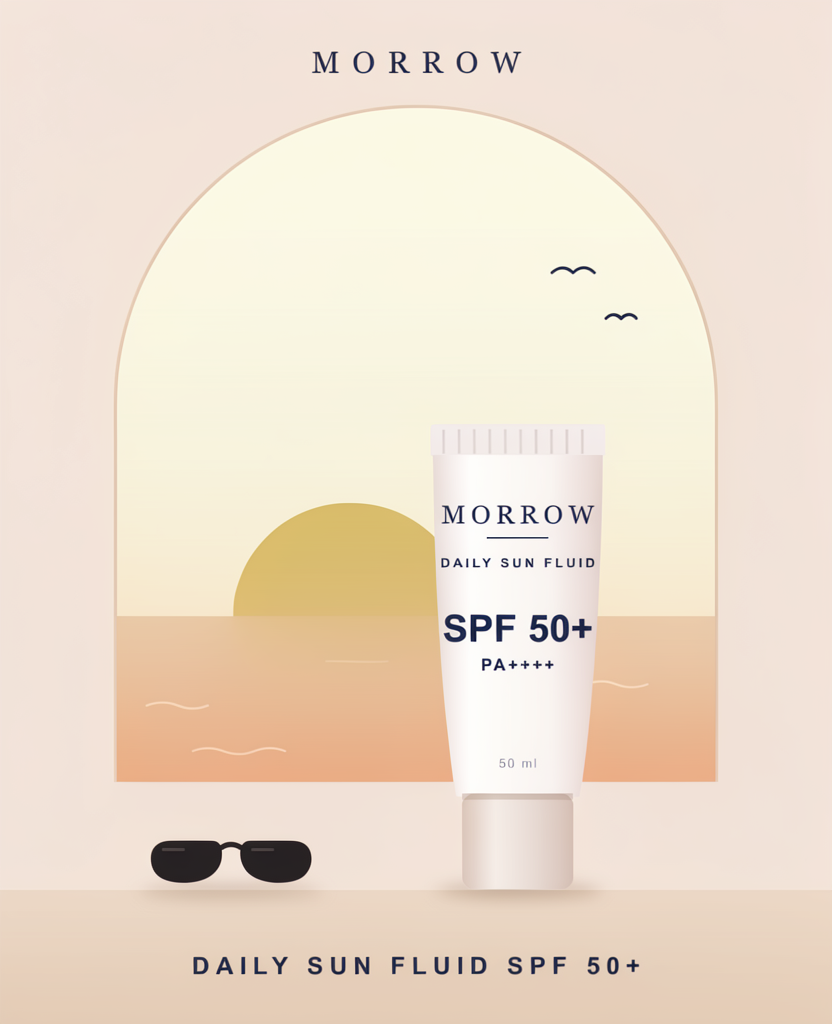

Drafted by the Magic Hour API from the findings below, including wording lettered into the artwork. It does not rename the product or move the launch date — those findings stand.
model flux-2-klein · 5 credits · one request, shown in full
POST https://api.magichour.ai/v1/ai-image-editor
{
  "name": "Second Look case rising-sun-rays",
  "image_count": 1,
  "model": "flux-2-klein",
  "aspect_ratio": "auto",
  "resolution": "1k",
  "style": {
    "prompt": "Make a minimal, surgical retouch of this advertisement image, not a redesign. Remove the radiating red rays inside the arch entirely and replace the panel with a flat warm gradient sky (cream to soft peach), keeping only the half-disc sun on the horizon and recoloring it amber-gold rather than flag red, with the (across most of the frame). Keep everything else exactly as it is: the product and its packaging, the logo and its placement, every piece of existing text and its legibility, the brand colors, the composition and framing, and the lighting and illustration style. Brand direction to respect: Keep the white tube, the arched window and the Morrow wordmark. Do not add any new text, logos, people or objects."
  },
  "assets": {
    "image_file_paths": [
      "api-assets/…"
    ]
  }
}
Report
- Critical
- 0
- High
- 0
- Moderate
- 0
- Low
- 0
- Markets analyzed
- South Korea, China
Reviewed by claude-opus-5 on Sep 22, 2026, against 12 documented incidents and 0 calendar entries.
- 1CriticalHistorical memoryKR, CN89% confidence
The red sunburst rays radiating from a rising sun in the arch reproduce the Japanese Rising Sun flag (Kyokujitsu-ki), a militarist symbol in Korea and China.
Marked regions: 1: Red rays radiating symmetrically from a red half-sun on the horizon, filling the arched window panel behind the tube In the image, across most of the frame
Red rays radiating symmetrically from a red half-sun on the horizon, filling the arched window panel behind the tube
The Kyokujitsu-ki — a red disc with red rays on white — was the flag of the Imperial Japanese Army and Navy and is read in South Korea and China as the emblem of colonial rule, wartime occupation and atrocities; Korean civic groups monitor and publicly call out its commercial use. The illustration here is not a generic sunburst: it is a red half-disc sitting on the horizon with evenly spaced red rays fanning across a pale cream field, the exact construction of the flag. The brand name 'Morrow' and the headline 'Light enough for every morning' push the reading further toward 'land of the rising sun', and as out-of-home the artwork is unavoidable on the street and trivially screenshotted into a side-by-side with the flag.
Grounding
Documented incident
Liverpool FC, Liverpool FC Rising Sun graphics (2019)
South Korea
Liverpool FC used Rising Sun flag imagery in content around the signing of Takumi Minamino; Korean fans complained, the club apologised on its Korea-facing page, and a repeat post deepened the backlash.
Outcome: Images removed; sustained complaints from Korean fans questioning the apology's sincerity.
Historical referent
Kyokujitsu-ki (Rising Sun flag) as symbol of Imperial Japanese militarism
South Korea / China
The red-rayed rising sun was the ensign of the Imperial Japanese Army and Navy during the colonisation of Korea (1910–45) and the invasion of China (1931–45). In both markets it functions much as Nazi iconography does in Europe, and its appearance in sport, fashion and advertising has repeatedly triggered organised complaint campaigns.
Documented incident
Li-Ning, Li-Ning collection likened to Japanese army uniforms (2022)
China
Chinese social media read army-green flapped caps in a Li-Ning show as Imperial Japanese Army uniforms, showing how sensitised the Chinese market is to visual echoes of Japanese wartime iconography.
Outcome: Share price fell sharply; brand apologised and the hats were reportedly scrapped.
Proposed change
Remove the radiating red rays inside the arch entirely and replace the panel with a flat warm gradient sky (cream to soft peach), keeping only the half-disc sun on the horizon and recoloring it amber-gold rather than flag red, with the sea band, birds and tube position unchanged.
Second Look is a first read, not a ruling. It reasons from a finite corpus of documented incidents and a partial calendar, and it can be wrong in both directions: it will flag readings locals would shrug at, and it will miss references it has never seen. The actual control is a reviewer who lives in the market. If you disagree with this finding, take it to them.